Showing posts with label Vedic revival. Show all posts

Sunday, March 17, 2013

Yes, We Are No Religion, part 2013

The TM organization (TMO) continues to insist that the TM technique is not a religion.  This may or may not be true of the technique itself.  However, if a TM meditator learns the advanced TMO technique known as the "TM-Sidhis program," the TMO calls him/her a "Sidha," and may send them emails like the one below.  From the following email, I conclude that the TMO is trying to propagate a Hindu-like religion.  What do you think?

The TMO sent this email to a TM-Free reader, who was kind enough to forward it to TMF.  Thank you!  Readers are invited to send us anything which may be of interest to other TMF readers.  I have edited the email for brevity:
------------------------------------------------------------------------------------------------------------------
From:  [one of the TM organizations - ed.]
To: xxxxxxx
Sent:  Nov 10, 2012
Subject: Nov 11-13 Broadcast Times for Global Celebrations
The Transcendental Meditation Program
NATIONAL COMMUNICATION OFFICE

Global Celebration Broadcast Times for

Dhanvantari Jayanti, Hanuman Jayanti, and Mahalakshmi

Dear Governors and Sidhas,

It is a pleasure to invite you to enjoy the global broadcasts on Maharishi Channel 3 on each of these beautiful Vedic Festival days taking place November 11th, 12th, and 13th.... 
You can connect each day on the Internet on Maharishi Channel 3:http://maharishichannel.in/....                   
Sunday, November 11, 5:55 pm (EST)—Dhanvantari(1) Jayanti:                                                                    
Celebrating the Birthday of Lord Dhanvantari, the eternal custodian of Ayur-Veda, the Science of Life, for living and enjoying the lively field of Immortality—the field of perfect health—in the midst of change. On this day of Dhanvantari, the tradition of the complete knowledge of Ayur-Veda is enlivened in human awareness and we can take advantage of this opportunity to imbibe in our consciousness the elements of perfect balance, perfect health, and immortality to help create a disease-free society.

Monday, November 12, 5:50 pm (EST)—Hanuman(2) Jayanti:
Enlivening Nature’s infinite organizing power for enjoying every wave of life in the fullness of bliss, in perfection, health, and happiness. The day of Hanuman enlivens those impulses of creative intelligence that help maintain the flow of evolution in an uninterrupted way and help remove obstacles on the way to enlightenment, thereby promoting Natural Law-based administration, Raam Raj, where society is free from problems and suffering.

Tuesday, November 13, 7:25 pm (EST)—Mahalakshmi(3) Celebration; Deepavali, the Festival of Lights:
Enlivening the qualities of prosperity, affluence, fullness, and fulfillment, and the glorification of all aspects of life—inner and outer—in every corner of the globe. The day of Mahalakshmi is one of the most important days in the Vedic calendar, enlivening all good everywhere and Heavenly Life on Earth. The Sanskrit word Mahalakshmi means “great wealth.” On this auspicious day we enliven the specific values of creative intelligence in nature that bestow prosperity, growth, wealth, and affluence; and eliminate poverty and remove obstacles and weaknesses in individual and collective consciousness.
Jai Guru Dev                                                                          
  -----------------------------------------------------------------------------------------------------------------            
 According to Wikipedia:
(1)  Dhavantari is an incarnation of the Hindu god Vishnu
(2) Hanuman is a Hindu monkey-god
(3) Mahalakshmi is a Hindu goddess

Do you think the TMO is misleading the public?  If yes, do you think it is doing so intentionally or unintentionally?  Why do you think it is doing that?  How do you feel about that?

Thursday, November 24, 2011

Is it a religion, or a dessert topping?

One of the more stupefying features of TM is its vague claim of not being a religion: "The Transcendental Meditation technique is not a religion or philosophy." But an overview of everything connected with TM practice - the organization and the people who teach TM - suggests something completely different. Religious aspects are woven throughout this entire enterprise that claims to be "scientific" in nature. In fact, the core doctrine of the organization which teaches TM is that of a religion. This religious organization holds that Transcendental Meditation and other practices in the program have an effect on the individual and society through means that can only be described as religious. The TM organization's stated goals of global transformation have many similarities to those of other religious faiths.

The TM movement's denial of its own obvious religiosity is absurd. As my title suggests, it brings to mind this great Saturday Night Live sketch. "New Shimmer's a floor wax and a dessert topping!"


"Shimmer Floor Wax", Saturday Night Live, January 10, 1976


"Tastes terrific... and just look at that shine!" But, as with Chevy Chase's rendition of the somewhat sleazy pitchman selling a surrealistic, self-contradictory product, something doesn't add up when it comes to the TM teacher's standard pitch concerning the relationship between TM and religious belief.

Critics over the years have pointed out that the religious nature of TM was proven by the decision in a Federal court case, Malnak v. Yogi, decades ago (1977). Yet promoters continue to insist that Transcendental Meditation is not a religious activity and may be implemented in public schools.

The following essay analyzes how the words and behaviors of the people and organizations promoting Transcendental Meditation mark it as a religious program. This is clearly demonstrated by current websites and online videos produced by the TM movement.


Tuesday, January 11, 2011

Making Sense of a Nonsensical Movement

The following is something I wrote earlier tonight as part of some private correspondence. It might be helpful in trying to make sense of the TM movement's nonsense, particularly when it comes to the constant insistence that TM is "not a religion." The truth of the matter is not easily explained, in large part because of inconsistent concepts as to what a religion is.


  1. The most accurate, broad self-characterization of "Maharishi Mahesh Yogi" and the organization he established ("Global Country of World Peace") is as a means of Vedic revivalism. "The complete theoretical and practical knowledge of the Veda and its profound significance for life has been revived and understood in a scientific framework by Maharishi’s Vedic Science and Technology..." which can be found in exactly this language here and here, and similarly elsewhere.

  2. While TM devotees attempt to separate "Vedic" from "Hindu," there is very little to support this separation, and what's effectively a simple word substitution. TM devotees often claim that their particular interpretation of ancient texts that they call "Veda" is the pure form of knowledge from which later traditions they consider corrupted, such as Hinduism, were derived. These assertions are evidently unique to those associated with the TM organization, and allied religious groups in India.  All that is being sold as "Vedic" under the TM organization's auspices, that was not reinterpreted, misinterpreted or completely manufactured by Maharishi and other group leaders over time, traces to the spiritual and cultural traditions of India that are usually referred to as "Hindu." However, much of it has certain unusual twists or doctrines unique to the organization. Among these is a group of males wearing crowns and white outfits who've paid 1 million USD to become "rajas" as part of a so-called "Global Government," and who may run the organization.

  3. Likewise, there is no support for describing any part of the Vedas as "scientific." The attempt to draw connections and parallels between aspects of the Vedas, Vedic or Hindu practices, and Western scientific concepts has been common among Hindus for decades if not centuries, and continues as part of the TM organization doctrine. There is no scientific support for such claims made by TM devotees. As an example, the organization has long claimed direct association between Vedic concepts and those of quantum mechanics, put forward by longtime TM devotee and American leader ("raja") John Hagelin. While Hagelin is a physicist, his pronouncements of this nature have gained zero support from others.

  4. Supremacy of the Vedas, and Vedic practices, is foundational to the TM organization's purpose, as it says at the bottom of this page under the title "Everything Should Be Vedic." This would include the folding of other cultures and other religious practices into a system in which Vedic practice is supreme. The gaining of alleged positive benefits at every level (personal/social/national/planetary), including the "world peace"  often referred to by proponents including David Lynch (and internally as "Heaven on Earth" or Sat Yuga), is the motivator for the organization's attempt to popularize "Vedic Knowledge." The products and services sold by the organization, of which Transcendental Meditation is usually one's initial contact, are the actual mechanism by which "Vedic Knowledge" is disseminated. Unlike TM, on which the organization has focused its efforts to obtain scientific research on which to base its claims of efficacy, there is very little, if any, research on any of the other product categories, listed at the bottom of this page.

  5. Note that in this description, things that are part of implementing this "Vedic knowledge" are practices, not beliefs.  There is no profession of faith or anything of that sort which many Westerners associate with "religion." It is in this way that TM and all the Vedic products are similar to consumer products, in that they are sold as being effective, but the buyer need not know, or care, or even believe in, the specifics of why or how they are effective. (Do you know or care why your stick of deodorant works?) The key activity becomes marketing, and everything to support the claims of efficacy in the marketing, which is why the organization seems obsessed with getting any possible support, no matter how shaky, preliminary, or unreplicated it may be from the scientific community it can possibly dig up. Incessant name-dropping of celebrities who sign on to the program is also part of this process.

  6. From the TM organization's view, the whole point is to recruit individuals into a system of practices, that are believed to be a correct, pure implementation of "Vedic knowledge," to bring about "Heaven on Earth." While prospective meditators are told in introductory lectures that the ultimate purpose is to bring about world peace, they are never clear about the details of how that's supposed to happen. World peace in this system is brought about, not through individual, personal development, but through adherence to Vedic "knowledge" in every detail across all aspects of life through the purchase and use of the organization's products and services by many people in aggregate. It is at this point where involvement with TM takes the form of participation in a religious enterprise without knowledge or consent; while the individual meditator may not need to believe anything, and may even deny belief, may even think everything about the organization is completely bogus, and in the practice of meditation (the introductory product) may not be doing anything even recognizable as a religious practice, the motivations of the teachers and marketers of TM are obviously in a different realm and of a different nature, are based in a belief system that holds to unusual notions of causation that are not clearly disclosed, and that would be considered by many to be religious, although unorthodox if not completely bizarre by Western standards.

    There is no rational or scientific basis for the claim that the more people adopt these products, the more likely "Heaven on Earth" will come about, in the same way that, to cover some of the more outrageous claims made for its other products, an east-facing home of proper Vedic proportions will give its owner health and wealth, spending hundreds if not thousands of dollars to have someone in India perform a ritual would likewise give the buyer health and wealth, or that bouncing on foam rubber while thinking certain thoughts... the list goes on like this for a while.  These more advanced products carry obvious spiritual or religious connotations, while the organization continues to insist that their basis is entirely "scientific."

    Meanwhile, the simple practice of meditation does provide some benefit for some people. For some, the initial benefit serves as validation for other claims made by the organization for its other products, and becomes part of the sales pitch for deeper involvement with its programs, and continues the intended intake path.


A longer post covering similar issues.

Monday, November 23, 2009

Let's Rewrite a New York Times Headline: Introduction to the Global Plan for Vedic Theocracy

Today I thought I'd juxtapose two items that recently came to my attention; two items that serve to illustrate the great gulf that can sometimes open up between the undeserved, glowing, fawning, uncritical (add more adjectives here) representation of Transcendental Meditation and the organization that sells it in the press, and the ongoing reality of what that organization is actually in the business of teaching, and what its goals are.

First, there's the horribly mistitled New York Times article that showed up on the Times' website this past Friday. In a skeptical world, with editors and reporters who actually worked to dig up the facts and put the claims made for such products into context, there would be something more in this article than a regurgitation of the same old things we've seen in TM movement press releases for the past few decades, and quotes from both TM salesmen and specially selected consumers of their product.

The title, "Can Meditation Curb Heart Attacks?" is one of those leading questions that snake-oil salesmen love, since they can then respond with the answer they've already prepared. In fact, that's the strategy of the TM sales pitch for decades, as founding TM salesman Maharishi Mahesh Yogi once stated during a TM teacher training course: "Every question is a perfect opportunity for the answer we have already prepared." The New York Times has set the stage, creating a vacuum into which the following stage-managed presentation perfectly fits. A better title might have been, "Vedic theocrats claim introductory technique of their faith curbs heart attacks." It would have from the beginning clarified who's making the claim, and the nature of the organization that's making the claim. Unfortunately my expectations of New York Times reporters aren't likely to be fulfilled in my lifetime; this is a sad benchmark of how poor the reporting is in one of the nation's leading newspapers today.

But wait, there's more! Featured at the top of this slightly rewritten press release masquerading as a New York Times story is an account of a 70 year old woman with high blood pressure who meditates. Clearly, meditating isn't the only thing she's been doing about her high blood pressure. See, it says so right there in the article:

Could the mental relaxation have real physiological benefits? For Mrs. Banks, the study suggests, it may have. She has gotten her blood pressure under control, though she still takes medication for it...

I think the cause of her blood pressure being under control is rather obvious, and it isn't the practice of TM. But that didn't stop the TM salesmen from putting one over on this reporter, claiming that instead of the scientifically proven benefits of those nasty nasty "pills" from "allopathic" doctors (the words that some TM devotees use for scientifically-validated medications and medicine), the magic words in somebody's head were the real cause of their lowered blood pressure. The best they can come up with, as a clear statement of TM's efficacy, is "could have;" those of us familiar with the ineffectiveness of the whole "health" regimen sold by the Transcendental Meditation organization would say, "probably not." The rest is just a tornado of blowing smoke, leaving the reader with an illusion that TM is proven to be something of value when the evidence, after decades of trying, is just not there.

Mentioned nowhere in this story is a connection, obvious to knowledgeable observers, that takes the sheen off this glowing report alleging TM effectiveness: the lead researcher, and the primary person quoted in this article, works for the same organization that sells the TM program. The reader can certainly tease it out if so motivated, since the researcher, Robert Schneider, is a medical doctor who's identified as a director of a "research institute" based at Maharishi Institute of Management. But not everybody knows that "Maharishi" is the founder of the organization that sells the TM program, and that should have been made clear to readers. Also evident is another of the TM movement's habits, of giving grandiose institutional names to various elements of TM promotions and assigning "directors" to them. While its name may create the impression that the "Institute for Natural Medicine and Prevention" is a large imposing white-columned building full of top-notch scientists working on the latest cutting-edge discoveries in their fields, the fact is that this "Institute" is probably just Schneider and a few associates, and the only means of "prevention" they're researching, or even the least bit interested in, are those things that are part of the faith-based, allegedly "Vedic" stable of "Maharishi" branded products and services.

Meanwhile, as the TM organization, with yet another uncritical promotional piece successfully placed with a prominent newspaper, makes another mark on its proverbial bedpost, there's the reality of what the less-obvious structure of this organization is up to. But here, the story is nowhere near as simple to tell. It's full of websites and e-mails full of language that makes the eyes of most readers glaze over; a lot of it is completely incomprehensible. Perhaps, then, a little explanation of what I think is happening here, and what the organization can be likened to, is in order, which can be summarized in a few sentences:

The Transcendental Meditation organization is a millenarian movement. That is, the main core belief of the organization centers on its particular concept of a future transformation of society and the planet.

While many people automatically assume that such movements center around Christian concepts of the "end-times" or similar ideas, movements based on other theologies, and other scriptural works, also exist. I would suggest that the underlying notion of massive social change put forward by the TM movement to various degrees in past decades finds a resonance, and a willing audience, in American culture because the idea of some future mass transformation is so common in religious culture here, and because of that, the idea is not automatically seen as strange or out-of-bounds.

The Transcendental Meditation organization is a Vedic revivalist religious movement. Similar to many other millenarian movements, it seeks to remake the world in its own image, based upon its contemporary interpretation of ancient scriptures. There is, of course, no previous thing to be "revived" since that is merely a myth of a glorious past; as with other such movements, the notion that all the movement is actually doing is putting things back to how they once were can be a motivator for some to work toward the movement's goals.

The organization works toward transforming all aspects of society so that society reflects its values, language, symbols and rituals. The TM movement thus has always had various subgroups seeking to gain entry into various fields; the "Institute for Natural Medicine and Prevention" I pointed out above is one such subgroup focusing on medicine. It has, through other small front groups, focused on other areas such as law, athletics, education, psychology and neuroscience, and of course it once sought direct involvement in government through its establishment of Natural Law Parties in a number of Western countries.

Perhaps the most audacious, or ridiculous, example of how the TM movement today is clearly a millenarian Vedic revivalist movement is its proposal that all existing cities be torn down and reconstructed to its proprietary designs based upon its version of Vedic architectural standards. Yes, it's true, they want to tranform the world so much that, given the opportunity, they'd probably bulldoze your house.

The Transcendental Meditation program is the point of first contact between this millenarian religious movement and the outside world, serving to recruit individuals to perpetuate the movement. Of course, if you were to walk up to someone and invite them to join a movement based on scriptures from some other part of the world, in a dead language that is certainly not their own, and that you wanted them to help take over and reconstruct everything, there would be very few takers. Instead, Transcendental Meditation is the means by which recruits are eventually introduced to all those things, and also, how the organization attempts to gain legitimacy in the surrounding culture. It is a product with a certain amount of value and utility in Western culture - that is, if the claims made for its benefits could be shown to be based upon something a bit more substantial than "the relaxation response" and the placebo effect.

The process by which an initiate learns TM includes some references to those religious and millenarian sorts of things, but they're couched in different terms. The Vedas are mentioned in passing as some vague source of where the knowledge of meditation came from, and the tradition in which TM's founder learned about meditation. The idea of a greater movement is introduced through references to "world peace" that, according to the movement, would result if only enough people meditated. Who could be against a movement that's working toward world peace? But that's merely a vehicle to eventually introduce the more esoteric parts of the TM belief system that certainly aren't going to be mentioned to a reporter writing about the alleged personal benefits of the movement's flagship product.

Because of this clear separation between inner and outer doctrine, any one person who starts the TM program may never come face-to-face with the weirdness and religiosity of the organization's belief system. Depending on how and where any one individual is initiated, and the degree to which they become involved in any of the other programs offered - advanced lectures, residence courses, and the like - such details may simply slip by in the torrent of information included in the process of learning TM. While many who learn TM may never have any further involvement with the organization, a few people will devote a significant portion of their lives to it, and it is those people on whom the movement will rely to perpetuate itself.

The TM movement, like many other movements of its kind, has always piggybacked on other trends in popular culture to legitimize and promote itself, most famously through its association with the Beatles. Today, that piggybacking continues in other ways, as with the example above where TM is styled as some kind of "alternative" offering in the healthcare field. Other contemporary attempts by the organization include the repositioning of its university as a center for learning in the fields of sustainable living, organic agriculture, and renewable energy. Again, the clearly religious and devotional aspects that are easily findable by various means on the Internet, and have long been discussed by those previously involved, are kept in the background if they are generally visible at all.

With all of that in mind, let's take a closer look at the e-mail that John Knapp posted here earlier today. I've extracted one paragraph, and bolded and italicized some parts of it in the light of the points I've just discussed.

The spiritual counterpart for your country lies in India. Each country is connected to one of the twelve jyotir lingas in India, the seat of Shiva, the eternal silence at the basis of creation. Reviving the age-old knowledge about the spiritual connection of every country with the Jyotirlingas in India and the creation of 48 Brahmananda Saraswati Nagars is Maharishi¹s greatest gift for humanity. The following website gives you more information about Maharishi's global plan to transform every country into a Vedic country:

So there it is in their own words: "Reviving the age-old knowledge" as part of a "global plan to transform every country into a Vedic country." The TM organization is a millenarian religious cult, and that's just from taking their own words at face value. There's this whole other world in the organization that teaches TM, and it's probably not anything like most people who read one of these recent newspaper articles about TM might expect.

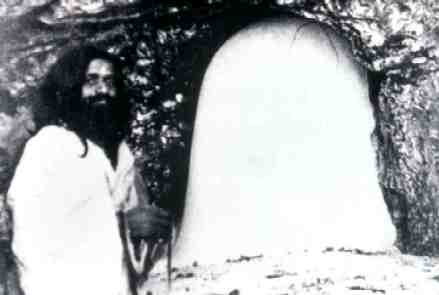
A young Maharishi Mahesh Yogi posing with an unidentified Shiva lingam. Photo from maharishiphotos.com
Perhaps the weirdest part of this, to Western sensibilities, are the references to "jyotir lingas." I'd written last year in some detail about how the movement's fascination with such lingas was involved in a since-abandoned project to immediately build "Maharishi Towers of Invincibility" around the world, including one in the Washington DC area. Simply put, a lingam is a symbol for the worship of the Hindu deity Shiva; the Jyotir linga are 12 temples in India where Shiva is worshipped. While the TM organization attempts to ascribe a scientific motivation for these references to deities, there is no way that a lingam, and the references to the Jyotir linga, can be taken in anything other than a religious context. In recent years an image of a lingam has been broadcast between programs on the Maharishi Channel, the movement's worldwide television channel.

Taken together, these references to religious symbols and places of worship, and the announced intent of the TM organization to "transform every country into a Vedic country" clearly indicate that what is being proposed is some kind of theocracy, where every aspect of life is lived in accordance to a particular interpretation of Vedic scripture. While some may assume that the movement's previous methods of getting as many people as possible to meditate would cause some kind of spontaneous transformation of society into one conforming to Vedic standards, the means or the specifics are quite irrelevant.

What I want to know is, why is an organization that clearly and ultimately wants to bring the entire planet into compliance with its religious beliefs getting free and unquestioning promotional assistance from the New York Times and all sorts of other media outlets?

Here's what I want to see. I want to see some enterprising reporter out there go do some digging, spending a little time and energy getting fluent in the subject, and eventually writing about how all those people you thought were laid-back former hippies now want to bulldoze the planet and remake every aspect of it conform to their crazy ideas, based on scriptures and beliefs which are clearly religious in nature.

Anything would be better than yet another rehash in print of the same old claims that the movement's been trying to make stick for over three decades now.